Sicily, the cradle of millennia-old traditions and culture, is also a vibrant hub of contemporary art. One of the most prominent artists bringing his art to the world is Antonino Siragusa, with his “Sicily” collection. The exhibition has stopped at some of the island’s most prestigious venues, but its visibility extended beyond Sicilian borders: it was even advertised on the famous digital billboard in Times Square, New York, confirming the international success of the artist.
The “Sicily” Exhibition: A Triumph in Taormina and Across Sicily
Antonino Siragusa’s “Sicily” collection was exhibited in some of Sicily’s most prestigious palaces, including the Palazzo dei Duchi di Santo Stefano in Taormina, the Palazzo D’Amico in Milazzo, the Palacultura in Messina, the Palazzo Cagnone in Francavilla di Sicilia, and the Biblioteca Regionale in Messina. These venues were the perfect stage for his works, celebrating the beauty and traditions of Sicily in a contemporary and innovative way. The exhibition was also featured in the Taomoda event calendar, confirming the strong link between art and fashion on the island.
Its success was amplified by the media visibility, culminating in the advertisement of the exhibition on the Times Square digital billboard in New York, which brought Siragusa’s works to the attention of an international audience.
The “Sicily” Collection: A Contemporary Interpretation of Sicilian Tradition
Antonino Siragusa’s “Sicily” collection consists of a series of paintings that stand out for their minimalist and symbolic approach. Each work is a modern reinterpretation of traditional Sicilian elements, such as the Sicilian cart, the Moor’s Head, and mythological figures like Mata and Grifone. These paintings pay tribute to Sicilian culture, told through simple lines and strong color contrasts that capture the essence of the island.

A significant work in the collection is the painting featuring the Moor’s Head, an iconic symbol of Sicily that evokes the famous legend of a tragic love between a young Sicilian woman and a Moor. Siragusa captures this symbol in a way that transcends folklore, creating a work that speaks to Sicily’s culture and history in a modern way.
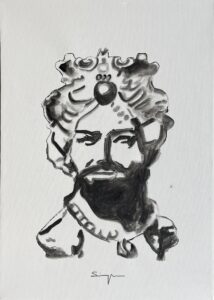
Among the other impactful works is the canvas depicting Mata and Grifone, the legendary figures from the history of Messina. These mythological figures are reinterpreted by Siragusa in a contemporary context, with expressive power that breathes new life into an ancient story.
The 4 Elements collection, showcased at the Taormina exhibition, is another key feature. These paintings express the deep connection between nature and humanity, using universal symbols and an artistic language that transcends the bounds of Sicilian tradition to embrace globally relevant themes.
The Painting of the Strait of Messina: An Impressionist Interpretation
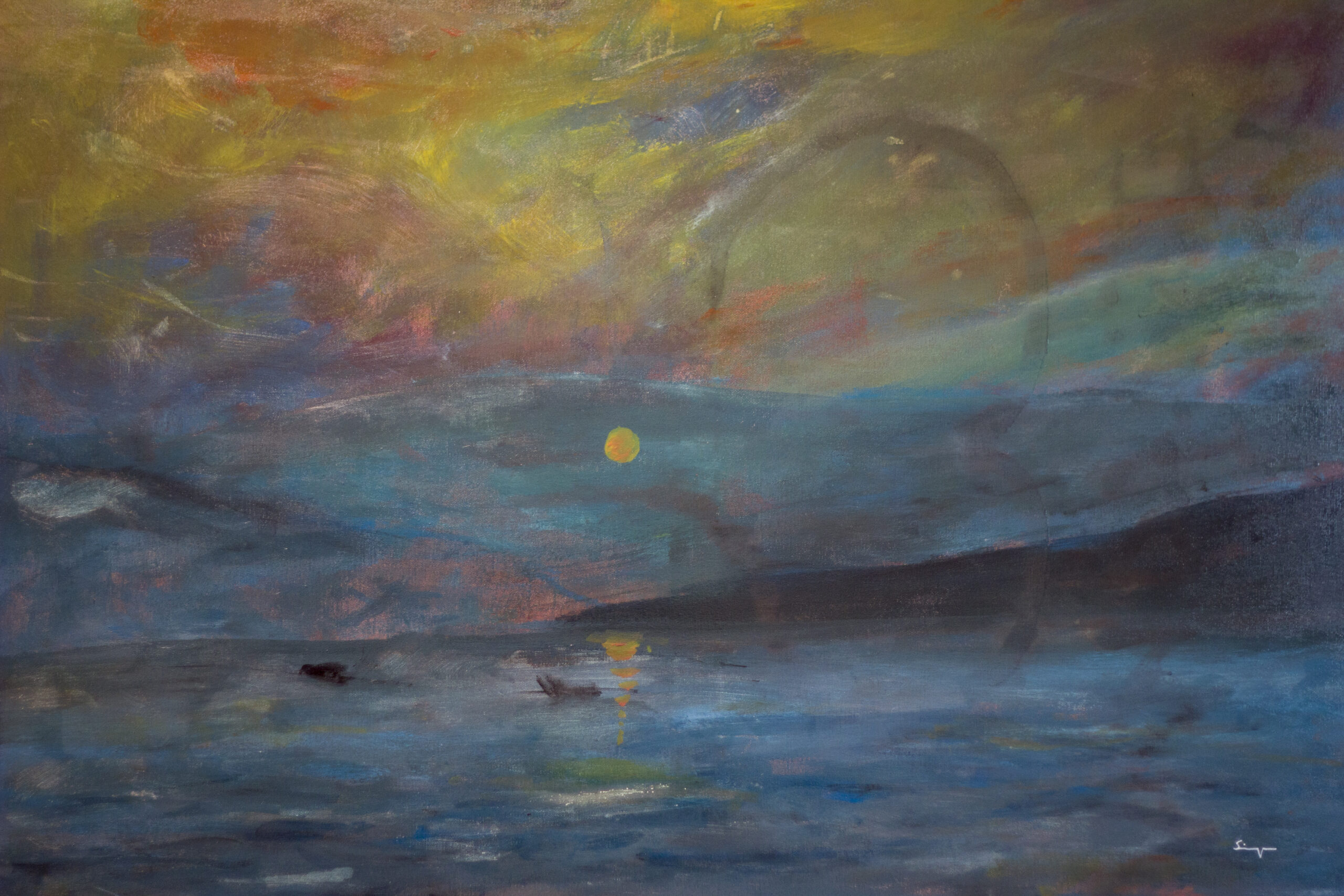
One of the most striking works in the exhibition is the painting depicting the Strait of Messina, an iconic theme for the city and Sicily. This impressionist-style painting, measuring 120 x 80 cm (approximately 47 x 31 inches), is a tribute to the Sicilian landscape, with its unique light and vibrant colors. Siragusa’s impressionistic technique captures the essence of this magical place, where the sea blends with the sky, and the mountains seem to embrace the land. The scene, although stylized, conveys a sense of movement and life, as if the Strait of Messina is living at every moment.
The Figs of India: A Tribute to Sicily
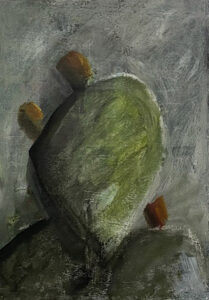
Another recurring element in Antonino Siragusa’s works is the fig of India, a quintessential symbol of Sicily. The paintings that feature figs of India reflect on the beauty of details and natural forms, elements that are integral to the Sicilian landscape. With a geometric composition and an intense color palette, Siragusa transforms a simple fruit into an artistic interpretation that captivates the viewer.
Antonino Siragusa’s Art: Minimalism and Symbolism
Antonino Siragusa’s art is a perfect balance between minimalism and symbolism. His ability to tell complex stories with few strokes and colors is what makes his art unique. Siragusa does not merely represent Sicily; he interprets it, reworks it, and presents it to the audience through a contemporary language that speaks to a living and ever-evolving tradition.
Each painting in the “Sicily” collection is a testament to the island’s deep cultural roots and natural beauty. The artist combines history and folklore with a modern vision, creating works that speak to both Sicilians and art lovers worldwide.
A Successful Exhibition That Conquered the Public
The “Sicily” exhibition has received widespread acclaim from the public, having been hosted in numerous prestigious Sicilian palaces. The audience, composed of art lovers, critics, and prominent personalities, had the opportunity to appreciate Siragusa’s work in historically rich settings, such as the Palazzo dei Duchi di Santo Stefano in Taormina, and the Palazzo D’Amico in Milazzo, which made the artworks even more captivating.
Among the notable guests were Ezio Greggio, Giulio Scarpati, and Vera Gemma, who visited the exhibition at the Palazzo D’Amico in Milazzo. The exhibition’s visibility was also amplified by its media presence, contributing to making the collection known to a broader audience.
The Future of Sicilian Art: Antonino Siragusa
The success of the “Sicily” exhibition goes beyond Sicily itself. Antonino Siragusa’s works are now appreciated internationally, thanks in part to the visibility gained from the Times Square advertisement. His art, which celebrates Sicily and its culture, has become a reference point for those seeking a modern and profound interpretation of Sicilian traditions.
For those who wish to learn more about the artist’s works, they can visit his official website www.siragusa.art or follow him on Instagram @ninosiragusa and @siragusaart. Siragusa’s works are also available at the Siragusa Art Gallery in Messina, located at via Centonze 61, for those who want to admire his art up close.